Monday, January 30, 2012

Tadaaki Kuwayama at Gary Snyder


Tadaaki Kuwayama had his first solo exhibition in New York in his late 20s in 1961 at the famed Green Gallery.   He was an early exponent for a radically new reductive language for painting.   In the past 50 years, he has shown all over the world and last week a  new exhibition of his work opened at Gary Snyder in Chelsea.  The new Snyder gallery space is the perfect setting for Kuwayama’s  beautiful work.

Snyder’s gallery is one of the few in New York that specializes in abstract art, similar to the role Eric Stark played in the 1990s in SoHo and Chelsea.  However,  Snyder has focused more on representing artist’s estates and re-igniting interest in overlooked or forgotten artists.  Tadaaki Kuwayama is an artist who has produced an extraordinary body of work , working quietly in his Chelsea studio while art fashions have come and gone.  He is revered in his native Japan but in America has remained known only among those keenly interested in abstraction. 

That has been changing over the course of the past few years beginning with a   wonderful show of his paintings from the 1970s in 2008 at Gary Snyder.   He is currently part of a show at the Guggenheim in New York focusing on 1960s monochrome painting and will be having major museums shows later this year and next in Japan and South Korea.   

The centerpiece of  this new show is a work comprised of 22 identical 8 x 8 x 2.25” panels of reddish anodized aluminum.   Spanning an entire wall, they are both monumental and light as air.   Behind that wall,  is a new floor piece made up of 8 identical units of anodized titanium.  They strike me as little Olitskis (the sprayed ones)  that somehow dematerialize.  The installation of his work at this show is of the highest order.  
The exhibition runs through February 25. Gary Snyder is located at 529 W. 20th Street, 10th floor 

Wednesday, January 4, 2012

In The Studio with Jocko Weyland

Jocko Weyland has been primarily known through his photographic works, his writings, and his cult zine "ELK." But recently he has made a major foray into drawing and painting and the results have been quite impressive.  His "China" drawings were first shown at Franklin Parrasch two-years ago and his first paintings more recently last fall in the group show  "SCRUFFY"  at KS Art in Tribeca.  I ventured over to Red Hook in Brooklyn to see what was up with Weyland's paintings and discovered some new gouache on paper paintings (all generally measuring one to two feet).  The source material for these paintings is his recent publication The Powder (Dashwood Books)  which is comprised of images culled from the pages of 1970s and early 1980s issues of the  magazine Powder--a lifestyle magazine centered on the then emerging glam world of skiing. 

Weyland has made delicate paintings of details of some of these images.  Some are oblique, while others make their referent obvious. I like the ones where I can get what they are better than the more obscure ones.  But he is already on to a technique that is producing some seductive surfaces to match his always keen color sense.  The next move will probably involve a bigger scale and most likely canvas but seeing his initial works makes the anticipation all the more exciting.

The work above is based on a detail photo of a ski

Wednesday, December 28, 2011

Nightmare on 53rd St.

Art as backdrop.....
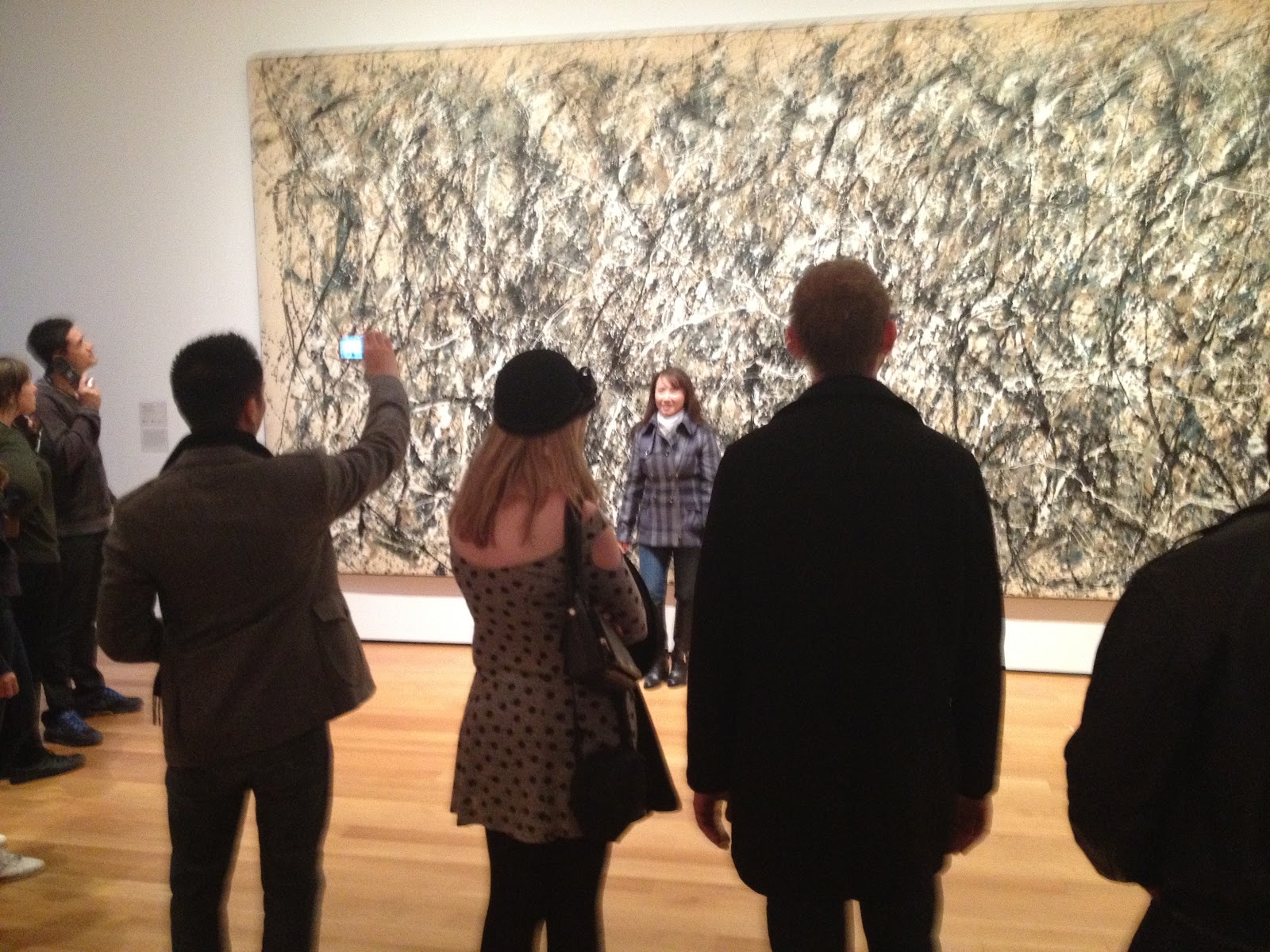
Today, I decided to pay one more visit to the de Kooning retrospective at the MoMA before it closes for good next week.  Having lived here for over 20 years, I know that the MoMA has become almost impossible to visit except on Tuesdays when it is closed to the public and various art educator events go on.  I have been to crowded museums in many places, but what I witnessed today was unprecedented--artwork being manhandled by adults and children and guards letting it happen.

Apparently the MoMA has no limits on how many people can be jammed into their $25 carnival of Modern Art. Yankee fucking Stadium has a seating capacity. Does the MoMA have a limitless capacity?  Are there no fire marshals?  The world's greatest collection of Modern Art is being presented in the most crass, disgusting anti-art atmosphere I have ever seen. The noise level is unbearable, the screaming children omnipresent and every artwork a mere photo op. The trustees and directors of this museum should be ashamed of themselves.  This museum is a shithole.  Period.  

Problem number one is that they place no limits on the amount of visitors because all they care about is making that $25 dollars, not making sure that the kind of care and time and talent that went into producing many of the works on view deserves some kind of reciprocal respect.  I'm sure Ronald Lauder is never around when the rabble is present.  How much money does the museum have to generate?  Is all the money going to the poorly paid clerks and guards?

Problem number two is that the Museum thinks that its good for business to have every tourist snapping pictures instead of looking at the art.  It's not even that they are taking pictures so much as taking pictures of themselves with the artwork. Every artwork is a photo op. The great Pollock painting above was just a backdrop for a slew of pretty girls to pose and mug and post the pic on Facebook asap.  This is the culture we live in.  Technology giveth but it taketh awayeth a lot.  Pity the poor soul who trekked in from Sydney on his first trip to the United States to view his favorite artist Jackson Pollock.... All photography should be banned at the museum.  Take a picture of yourself outside the museum in front of the MoMA sign.

Worse than anything I have described was the rampant touching of the artwork by museum visitors.  I verbally castigated a guard who was asleep at the wheel as usual as a Judd brass box was finger pawed by several children. That work always looks like its been treated like shit and the Judd Foundation should have it removed from the museum. A Lee Bontecu relief became the source for much amusement and was banged several times by visitors posing in front of it.  The worst treatment of all was reserved for a recent acquisition, a De Wain Valentine 1966 fiberglass/polyester sculpture and gift from Marie Josee and Henry Kravis last year (see photo above).  Unfortunately, the museum doesn't think too much of that gift since it lets passerby after passerby cop a feel.  I saw at least 5 people in 15 minutes touch it as they walked by.  One hapless guard can't see everything.  Eventually this beautiful gleaming example of West Coast Minimalism brought to the New York art world's attention by Tim Nye will look as shabby as the Judd does. 

That's why Donald Judd left for Marfa.  He knew that museum people didn't ultimately care about the preservation of artworks so much as the preservation of their careers.  I will be writing at length about Judd's vision in Marfa in the coming weeks but the man cared more about art than the trustees of the MoMA and the people who run the museum.  I used to lament that Dia:Beacon was 90 minutes from the City, but now I see that as one of its great strengths.  Keep the art as far away from the people as possible.  That's the only way it will physically survive unless a whole new set of policies are put in place.

I was amused by how the the curators decided to mix things up a bit and so I saw LOTS of work by Marcel Broodthaers and Daniel Buren from the newly acquired Daled Collection. This dreary assortment particularly by the supremely overrated French hack Daniel Buren was the one empty gallery in the entire museum.  Yes, it was those tarps of stripes that the Octoberists masturbate to.  Lots of snickers at the sublime Ryman painting Twin 1966, though.   That one had people wondering WTF.  But it's easily one of the 10 best works in the entire museum.  I can also say that I finally saw a Lawrence Weiner work that was great--a drywall cutout and a Robert Barry piece from 1968 that looked a little too much like a Fred Sandback for comfort.  It's too bad that we can't see work here in New York by the only great artist produced by the whole Institutional Critique genre--Michael Asher, instead we get  Broodthaers and Buren who are like double doses of chemotherapy.  

Willem de Kooning at MoMA

I made my second visit to the Willem de Kooning retrospective because the exhibition closes in a few days and I had not yet written about it.   The gushing reviews by critics like Barry Schwabsky in The Nation and Howard Halle in TONY seemed to capture my general feeling. However I don't agree that there wasn't a bad painting in the show.  There were quite a few crummy ones, particularly from the 50s throughout the late 70s.  

The early works are stunning in their utter virtuosity with both drawing and painting.  From the portraits to the pink angels of the early 40s to the black and white paintings to the titanic achievements of Attic and Excavation in 1950 it was a singular march towards greatness.  Then came the Women.  The Women suck.  They are gimmicky and dumb.  It was a bad lapse.  I now have to say once again that Greenberg was correct.  The abstract paintings that immediately followed in '53-'55 (using the same palette as the Women) were very good--Gotham News and Interchange among them.  But then decades of mediocrity follow. The big brash abstract paintings like Merrit Parkway don't hold up. Few of these do except for 1960's Door to the River.  I know this will be heretical to some, but second generation de Kooning acolytes like Michael Goldberg and Al Leslie were arguably making better paintings than Bill at this point.  

The 1960s were not a good decade for de Kooning witness the Sag Harbor stuff.  It's only in the late 70s that his paintings appear to become more focused and not so forced.  And then seemingly out of nowhere in the 1980s we get the astonishing late paintings. These are his greatest works and among the greatest paintings in Modern Art. The effortless flow of line, the white light that animates the entire surface, the lack of clutter and abex bravado (the letting go of a certain weightiness).  These are timeless works.  They are familiar yet look like nothing that had come before.  

Tuesday, December 27, 2011

Helen The Bridge Dead at 83

Few artists in the New York School of the past 70 years have had as privileged a life and background as Helen Frankenthaler, the painter who died yesterday at the age of 83 after a long illness.  She was a glamourous figure in the New York art world and was lovers for some years of Clement Greenberg and then married painter Robert Motherwell years later. She painted some very beautiful paintings.  A few were even great.

But there is a tragic dimension to her that rests on the general consensus that she wasn't a great artist.  Despite getting all the official plaudits and medals this country could bestow on an artist, Frankenthaler never got what she probably most wanted--the recognition of the art world as to her centrality to the evolution of painting after  Abstract Expressionism.

Her main problem was this:  the two most important critical champions of Color Field painting (Greenberg and Freid) rated her below the boys. In Greenberg's canon--after Pollock and Newman came Louis, Noland and then the painter he considered the greatest since Pollock, Jules Olitski.  For Fried, the canon ran from Pollock to Louis, Noland, Stella, Olitski and Caro.   In neither man's writings do we ever get anything about the greatness of Helen Frankenthaler.  She will forever be the bridge-- the bridge from Pollock to the D.C. boys--Louis and Noland. 
And truth be told, she didn't consistently paint anything as good or original as  Louis' Veils or as perfect as Noland's Circles or Chevrons, or as novel as Olitski's controversial spray paintings. 

When the Color Field movement ebbed in the late 60s, abstract painting had entered into the  more reductive anti-color strictures of Ryman, Martin, Baer and Mangold. Louis had died, Noland would eventually become irrelevant and Olitski reinvented himself as the impasto king (eschewing color for surface) and bringing all the other former Color Fielders with him--Poons, Bannard and others.  Helen was left all alone. She never abandoned the basic vocabulary she established with Mountains and Seas 60 years ago.

I'm no believer in the necessity of the romantic idea of the impoverished or tormented artist, but she could have been much better. Louis painted in the tiny living room of his little house.  He had to figure out how to make large works in that space.  With little ventilation, he sucked on the paint vapors for years until they gave him lung cancer and he died.  Helen's studio was bigger than Louis' house.  She could have anything she wanted.  Perhaps her life was too easy and her work became too easy.   

Tuesday, December 6, 2011

Texas Trip UPDATE


My recent trip to the Lone Star state over Thanksgiving allowed me to check out Marfa and Houston and lots of art--mostly stuff made here in New York.  Many have been asking me for a full report, but it will take some time.  In the meantime, above are unauthorized photos from the Menil Collection, Barnett Newman's titanic Ulysses, 1952,  and directly above from the Judd Foundation tour some early Judd wall and floor  pieces.